









Giraffe Logo

nirav sawant

ESC
AI AND ROBOTICS

Engineering Intelligent
Autonomous Systems.

Embedded Systems • Control Theory • Machine Learning • GPU Computing

Mechatronics engineering student building real-time perception pipelines and control systems for robotics applications. Passionate about bridging hardware and software through embedded systems, CUDA acceleration, and safety-critical software design.

me

about me

I'm a Mechatronics and Robotics Engineering student focused on building reliable, production-minded autonomous and embedded systems. My interests span robotics integration, perception pipelines, and software that has to work under real-world constraints, not just in controlled environments.

I approach projects and internships from a systems perspective, overseeing interactions between components, defining and maintaining interfaces, managing version control history, and actively reducing regression risk as systems evolve. I care as much about how parts fit together and scale as I do about individual algorithms or features.

I've applied this mindset through hands-on robotics development in coursework, as well as contributions to open-source autonomous driving software, where code quality, review standards, and long-term maintainability matter the most. I enjoy working in environments that treat engineering as an end to end discipline, from testing and design to deployment and iteration.

Long term, I'm aiming to work on real-world autonomous systems where performance, safety, and reliability are non-negotiable.

experience

June 2024 - August 2024

junior AI content strategist

legacy+

championed communication with marketing/analyst teams
created ai tools to streamline development of educational content for partnering organizations

react node.js aws
May 2025 - August 2025

software engineer intern

cibc

Championed concept of SDLC
Contributed to multiple production level projects within the bank
Championed communication with analyst teams, and gained a thorough understanding of the commercial banking industry

react node.js aws

projects

jenga-safety-gate

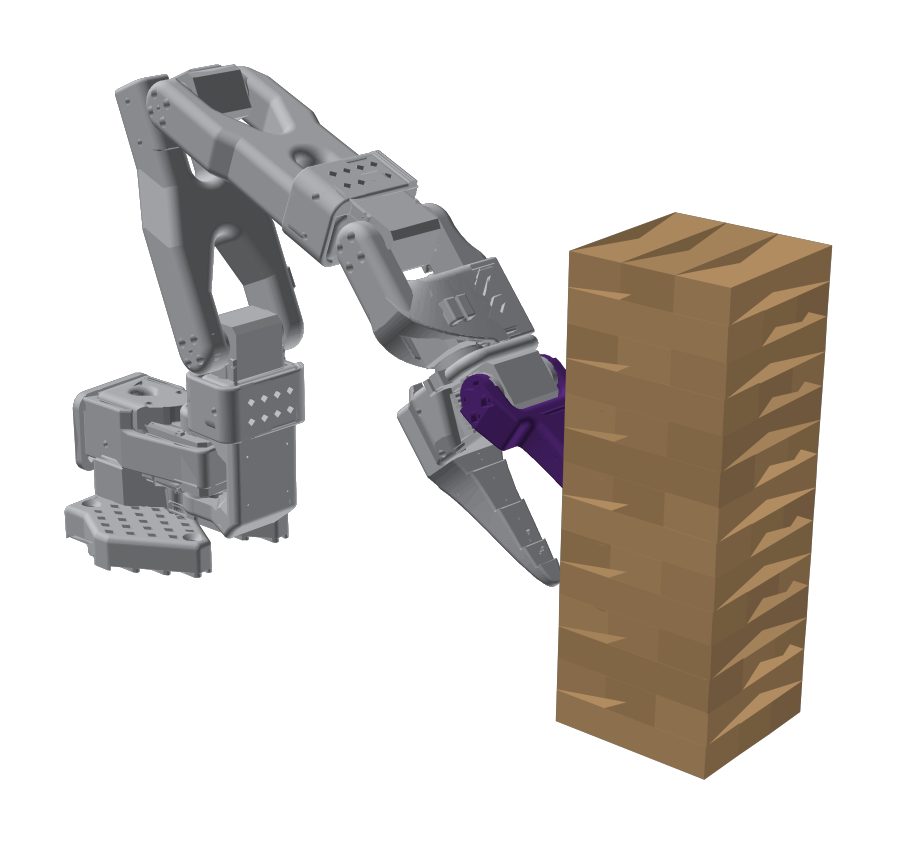
Testing whether a world model's epistemic uncertainty, rather than its point prediction, should hold veto authority over a robot's action. An SO-101 arm extracts Jenga blocks behind a fail-closed safety gate driven by a V-JEPA-distilled anomaly detector, scored against an ungated control group on the same held-out scenarios. Classical CV provides ground-truth tower state so the evaluation isn't circular.

Python LeRobot OpenCV V-JEPA Robot Safety

Autodidax

Treating learning as a control problem. Autodidax maintains a belief about your cognitive state and picks instructional actions that optimize for actual long-term learning. Uses meta-learning to adapt fast to new learners and POMDP-based planning for personalized instruction.

Julia Flux.jl Machine Learning Education Tech

latent-failure

Generative discovery and analysis of structured failure modes in autonomous robotic systems.

Python ROS 2 Machine Learning Autonomous Systems

Invariant

Invariant explores a missing layer in modern robotics: the governance of complex systems using machine learning informed by control theory. Its purpose is to treat workflows themselves as dynamic systems in order to make robotics development more predictable, reproducible, and trustworthy.

Python Control Theory ML Governance Robotics

motion-aware-perception-model

CUDA accelerated machine learning perception model for robotics applications. Leverages GPU parallelism for real-time sensor fusion and object detection in dynamic environments.

CUDA C++ PyTorch Robotics Perception

Contact Me

my thoughts

Uncertainty, Not Prediction, Should Hold the Veto

August 2026

A world model is least accurate exactly when it matters most. The full experimental plan for testing whether epistemic uncertainty is a better safety signal than a point prediction. Frozen control condition, locked gate threshold, and a result I am prepared to have go against me.

Robotics Safety World Models Experiment Design

Three Things People Mean by "Pause and Think"

August 2026

Staying able to stop, thinking harder when unsure, and knowing when to ask a human are three different mechanisms with three different failure modes. Only one of them is actually hard, and it gets the least attention.

Safety Uncertainty Reachability

The Attestation Layer

August 2026

The blocker on unattended autonomous work isn't capability, it's that nobody with liability exposure will accept a robot's own self-report. What changes when you design the monitor for a skeptical third party instead of for yourself.

Robotics Runtime Monitoring Trust

Why AI Won't Outsmart Natural Intelligence

August 2026

Not a claim about benchmarks, which machines will win. A claim that "smarter" needs a shared purpose and there isn't one: natural intelligence is a survival system that generates its own stakes, and that position isn't reachable by scaling.

Psychology Cognitive Science Embodiment

Learning as a Control Problem

January 2025

Exploring how Autodidax treats instruction as a control problem, using meta-learning and belief filtering to optimize for long-term learning outcomes rather than immediate performance.

Machine Learning Education Tech Control Theory

GPU-Accelerated Computing in Modern AI

January 2025

A deep dive into CUDA programming, the GPU computing paradigm, and how parallel processing enables real-time perception in robotics applications.

CUDA GPU Computing Deep Learning

Reach Out

Email

please feel free to reach out to talk about your projects!

niravsawant22@gmail.com

LinkedIn

let's connect!

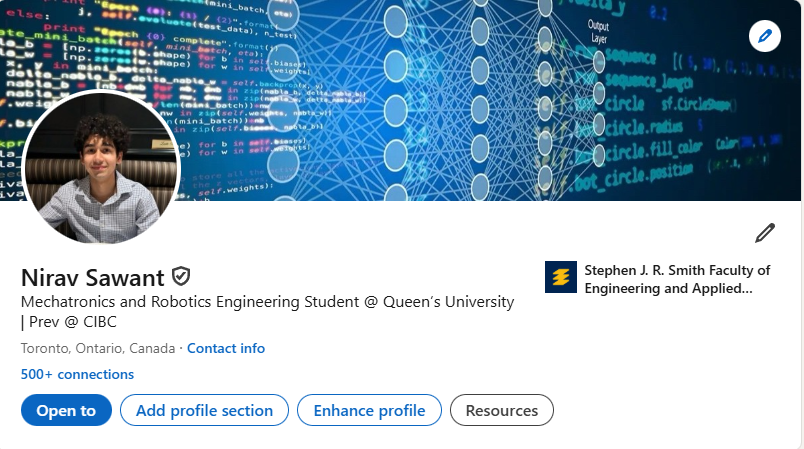
Nirav Sawant
Open
LinkedIn profile preview for Nirav Sawant

GitHub

Check out my code

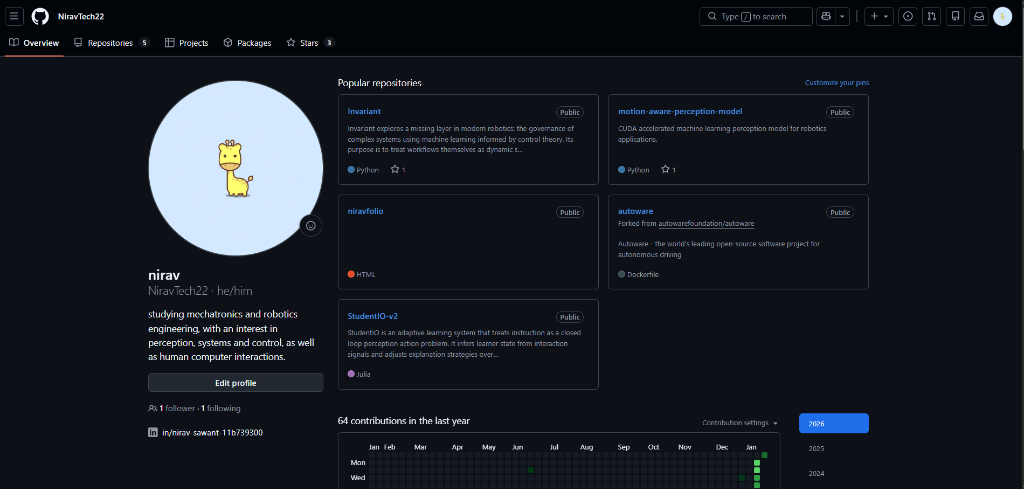
GitHub NiravTech22
Open
GitHub profile preview for NiravTech22